I want to say to you, read the book, the Pearl of Great Price, and read the Book of Abraham. The Pearl of Great Price I hold to be one of the most intelligent, one of the most religious books that the world has ever had; but more than that, to me the Pearl of Great Price is true in its name. It contains an ideal of life that is higher and grander and more glorious than I think is found in the pages of any other book unless it be the Holy Bible. It behooves us to read these things, understand them: and I thank God when they are attacked, because it brings to me, after a study and thought, back to the fact that what God has given He has given, and He has nothing to retract." - Levi Edgar Young, Conference Report (April 1913), 74

"...it must be evident to all who seriously consider the matter, that if the Book of Abraham as given to us by Joseph Smith be true, it must have been translated by a greater than human power." - George Reynolds, The Book of Abraham: Its Authenticity Established as a Divine and Ancient Record (Salt Lake City: Deseret News, 1879), 4

Wednesday, May 18, 2011

Parley P. Pratt on The Book of Abraham

The following comments were published by Parley Pratt, Apostle and Editor of the Millennial Star, in the 1842 issue of the LDS periodical, as a preface to the publication of the Book of Abraham. Elder Pratt's comments provides some of the history of the finding of the papyri and mummies that the Church purchased in 1835.


Tuesday, May 17, 2011

The Apocalypse of Abraham

The following translation of the Apocalypse of Abraham, from the Romanian text, by Dr. Moses Gaster, was published in the Transactions of The Society of Biblical Archaeology in 1893.


Tuesday, April 26, 2011

The Ulterior Motives of Reverend Franklin S. Spalding


Reverend Franklin S. Spalding1

Almost 100 years ago, Reverend Franklin Spencer Spalding, an Episcopalian Bishop in Utah, published a 36 page booklet that was circulated amongst LDS officials, college professors, high school teachers, and students.2 The pamphlet was meant to discredit the Book of Mormon by illustrating that Joseph Smith's ability to translate the facsimiles contained in the Book of Abraham could not hold up to the scrutiny of Egyptologists. If Reverend Spalding could successfully illustrate that Joseph did not translate Egyptian accurately, then it may be inferred that his translation of the Book of Mormon should not only be called into question, but dismissed altogether. Apparently it did not occur to Reverend Spalding that the success of his experiment was dependent on some logical fallacies, a subject that will be addressed in a later posting; nevertheless, Spalding's efforts elicited quite a response in relation to some potentially serious implications for the Book of Abraham.

Friday, January 7, 2011

RC Webb - The Case Against Mormonism

Despite its foreboding title, Robert Charles Webb's book The Case Against Mormonism, is an apologetic work defending Mormonism against the common anti-Mormon arguments prevalent at the time it was published. Webb himself was not a member of the Church of Jesus Christ of Latter-Day Saints, but was favorable to their cause.1 The book was published in 1915 in New York, and came mostly as a response to Reverend Henry C. Sheldon, a Professor at Boston University, who had written a book entitled A Fourfold Test of Mormonism.2 Sheldon briefly discusses the Book of Abraham facsimiles and the responses of Egyptologists consulted by Reverend Franklin S. Spalding, and previously by Jules Remy. Webb's book briefly addresses these particular issues, as well as Sheldon's approach. This portion of Webb's book is included below.3


_________________________
1 'Robert Charles Webb' was a pseudonym for James Edward Homans.  Homans was a Harvard graduate who had studied at the Harvard Divinity School.  He was an Episcopalian and was a writer by profession. He was friendly towards the Church of Jesus Christ of Latter-Day Saints, and had published articles and books relating to Mormonism previous to this publication, and subsequent thereto; see Kevin Barney, "Robert C. Webb," By Common Consent; also see Sidney B. Sperry, "The Story of Research on The Pearl of Great Price," in Pearl of Great Price Conference, December 10, 1960, ed. James R. Clark (Provo, UT: Department of Extension Publications, Adult Education and Extension Services, Brigham Young University, 1964), 6-11; additionally, see James E. Talmage Diary, dated December 1, 1915 (typescript in my possession):  "About noon I received a call, as per prior arrangements, from James E. Homans.  We lunched together and spent some time in the discussion of the work on which Mr. Homans has been for some time engaged, the preparation of articles and books on subjects relating to Mormonism.  Mr. Homans delivered to me today a copy of a 157 page work entitled "The Case Against Mormonism" by himself.  Instead of his own name he uses on the title page the pen-name, Robert C. Webb, under which he has written in this particular field of literature. The book is a reply to a little work which appeared somewhat over a year ago, entitled, "A Fourfold Test of Mormonsim" by Prof. Henry C. Sheldon, of Boston University.  The Webb's [sic] reply is published by L.L. Walton of the Sturgis and Walton Company. In company with Mr. Homans I visited the offices of Sturgis and Walton, and ordered five hundred copies of "The Case Against Mormonism" to be shipped at once to the office of the Deseret News, Salt Lake City."
2 Henry Clay Sheldon, A Fourfold Test of Mormonism (New York: Abindgon Press, 1914), 23-25
3 Henry C. Sheldon's book is not included in the Documents on this blog because there is no original insights produced in his writing; he simply summarizes Remy's findings, which is available here; and Spalding's findings, which is available here.

Theodule Deveria - Memoires et Fragments

In 1855, Jules Remy (a Frenchman) and Julius Brenchley (an Englishmen) visited Salt Lake City.  Upon their return home they presented to Theodule Deveria "drawings which we borrowed from the Mormons [the Facsimiles from the Book of Abraham]" with a request that he would translate them from Egyptian into French. Deveria obliged, and his translation made in 1859 was subsequently published in 1860 by Jules Remy in his book Voyage Au Pays Des Mormons.1 

At the time of translation, Deveria was a young Egyptologist working in the Louvre Museum. He first took an interest in Egyptology at the age of seventeen and subsequently obtained an education from the College of France. In 1850 he performed some Egyptian translations for the Sevres Museum (Paris, France), and in 1851 he began working in the print room in the National Library. In 1855, Deveria began work at the Louvre Museum in Paris, and five years later he was appointed as Assistant Curator of the Egyptian Museum (at the Louvre).2 Before turning thirty years old, Deveria, described as a "young savant," provided Remy with his translation of the facsimiles.3


 Theodule Deveria4

Wednesday, January 5, 2011

Messenger and Advocate - December 1835

The first published description of the acquisition of mummies and papyri by the Church from Michael Chandler, was in the LDS Church periodical Messenger and Advocate.  This publication reproduces a letter written by Oliver Cowdery to William Frye, regarding the mummies and papyrus, with some observations and speculations on the acquired materials.  The letter was published in Messenger and Advocate 2/3 (December 1835):233-237.  This letter was also reproduced, in part, in the History of the Church; however, B.H. Roberts (editor) provides this information in the first person narrative (i.e., Joseph Smith), rather than the actual author, Oliver Cowdery.The information below provides some very important details in assisting to identify the materials then owned by the Church, and adds context to understanding the papyri currently owned by the Church.


TBH Stenhouse - The Rocky Mountain Saints

Thomas Brown Holmes [T.B.H.] Stenhouse, a British convert and one time missionary companion to Lorenzo Snow, was the first Mission President over the Swiss Mission.1 While serving as Mission President, he edited a pro Latter-Day Saint periodical entitled Le Reflecteur [The Reflector], and published a book entitled Les Mormons Et Leurs Ennemis [The Mormons and Their Enemies],2 which was written for the purpose of defending the faith and exposing popular anti-Mormon arguments that were promulgated at that time. Despite these accomplishments, Stenhouse later became disaffected and apostatized from the church, and with his wife Fanny, joined the Godbeite movement.3 In 1873 he published an expose against the church, presumptuously entitled, The Rocky Mountain Saints: A Full and Complete History of the Mormons.4  Within the book he devotes a chapter to the Book of Abraham, borrowing freely from Jules Remy's publication, wherein, Joseph Smith's explanations of the figures in Facsimiles 1-3 are juxtaposed with M. Theodule Deveria's transation of the same.5  This was done for the purpose of trying to prove that Joseph Smith could not translate Egyptian. The comparison is prefaced by a brief history of the mummies and papyri in church history.

Stenhouse's publication has become a standard for anti-Mormons who wish to attack Joseph Smith's ability to translate. His publication has frequently been employed by Joseph's critics over the past 130+ years, although the translation comparison never receives attention past the surface level differences. A response to Stenhouse's publication, which had a much broader dissemination than Remy's book, was provided by Elder George Reynolds, a Seventy in the Church of Jesus Christ of Latter-Day Saints. Reynolds was the first person to attempt to understand the meaning of the Egyptian explanations for the purpose of identifying similarities between Egyptian beliefs and Joseph Smith's explanations of the Facsimiles. Reynolds also discusses other historical issues in connection with the Book of Abraham, offering a scholarly approach to defending the authenticity of that book of scripture. His response was published serially in the Latter-Day Saints' Millennial Star, beginning in 1879, and also published that same year in booklet form, in Salt Lake City, Utah. In this sense, Reynolds was the first apologist for The Book of Abraham.

Thursday, December 23, 2010

The Book of Abraham-It's Genuineness Established (George Reynolds - Millennial Star 1879)

The Pearl of Great Price was originally published in 1851, in London, England, by Apostle Franklin D. Richards.  It wasn't until 1878 that it was printed in the United States, and subsequently canonized by the church in 1880. In connection with the republication of the book in 1878, Elder George Reynolds wrote a book offering "a few chapters written to prove its genuineness and divine origin."  This was believed to be beneficial as "very little has ever been said by the Elders of the Church in advocacy of its claim as an inspired record..." Additionally, Elder Reynolds stated that "while the people of God have said or written little in its defense, there have been those opposed to the revelations of God in these days, who have vigorously attacked it, who have styled its language "gibberish," and classed it among the "pious frauds" that have so often disgraced the history of religion, Christian and heathen."1 Elder Reynolds' response to these accusations forms the first apologetic and scholarly approach to discussing the Book of Abraham and Joseph Smith's translation thereof. 

His response was published piecemeal in London, England, in the Latter-Day Saints' Millennial Star.  During that same year, it was published as a booklet in Salt Lake City, Utah; all this amongst his legal difficulties relating to the practice of plural marriage. In 1878, Reynolds noted in his journal that he was studying outside "authorities" in relation to Abraham and other subjects.2  On January 6, 1879, Elder Reynolds was convicted in the famous Reynolds v. the United States case;3 the same day the first issue of Reynolds treatment on the Book of Abraham appeared in the Millennial Star.  The publication of his book in the Millennial Star is provided below.

Jules Remy - A Journey to Great Salt Lake City

As related by Elder George Reynolds in the Millennial Star in 1879, Jules Remy and Julius Brenchley visited Utah in 1855. On their return home to Paris, France, they brought with them a copy of The Book of Abraham,1 "which they placed in the hands of "a young savant of the Museum of the Louvre, M. Theodule Deveria," with the request that he would translate it. This he attempted to do. Messrs. Remy and Brenchley afterwards published an account of their travels, and embodied therein M. Deveria's soi-disant translation."2 This translation of the facsimiles into French was published by Jules Remy in 1860 in Paris, France, being his second volume relating to his "Journey to the Land of the Mormons." The next year an English addition appeared in print, "scrupulously revised," and retitled, A Journey to Great Salt Lake City.3

The first LDS response to the French publication came from Louis Bertrand, the LDS Mission President over France at that time. Bertrand was converted to the Gospel through John Taylor, and Bertrand substantially assisted Elder Taylor in translating the Book of Mormon into French. Bertrand's response to Remy was included in his book entitled Memoire's D'un Mormon [Memoirs of a Mormon], published in Paris, France, in 1862.

The extent of Remy's publication seems to have had limited circulation among the Latter-day Saints because this issue wasn't addressed again in print until George Reynold's response was published in 1879, six years following T.B.H. Stenhouse's publication of The Rocky Mountain Saints.4 Stenhouse plagiarized Remy's book by reproducing Deveria's translation of the Book of Abraham facsimiles which he then compared with Joseph Smith's explanations of the same. Stenhouse's publication is the most frequently used source by critics of Joseph Smith regarding translation of the Book of Abraham. Although Remy's book only includes one illustration of the facsimiles, Stenhouse's book includes all three (along with Deveria's translation of each). Many online and printed sources that are antagonistic of Joseph Smith still use Deveria's 150 year old translations as their primary support for critiquing Joseph's ability to translate.

The English publication of Remy's book is available below.

Wednesday, December 1, 2010

Reponse to Daniel Kidder - Times and Seasons

Subsequent to the publication of Mormonism and The Mormons, a response, written by the paper's editor, was published in the Times and Seasons in September 1842.1 It is apparent that the writer of this response did not deem Kidder's satire of the Book of Abraham worthy of specific comment. Kidder's book is compared to other's attacks against Joseph Smith and the Church, and is recognized as just another instance wherein the Saints will be blessed for having been falsely spoken of for Christ's sake. Kidder's book marks the first published criticism of the Book of Abraham, and Facsimile 1 associated therewith.  The response to his book is included below, which is an extraction from the Times and Seasons:


Jules Remy - Voyage Au Pays Des Mormons

As related by Elder George Reynolds in the Millennial Star in 1879, Jules Remy and Julius Brenchley visited Utah in 1855. On their return home to Paris, France, they brought with them a copy of The Book of Abraham, "which they placed in the hands of "a young savant of the Museum of the Louvre, M. Theodule Deveria," with the request that he would translate it. This he attempted to do. Messrs. Remy and Brenchley [sic] afterwards published an account of their travels, and embodied therein M. Deveria's soi-disant translation."1 This translation of the facsimiles into French was published by Jules Remy in 1860 in Paris, France, being his second volume relating to his "Journey to the Land of the Mormons." The next year an English addition appeared in print, "scrupulously revised," and retitled, A Journey to Great Salt Lake City.2

The first LDS response to this French publication came from Louis Bertrand, while serving as the Mission President over France. Bertrand was converted to the Gospel through John Taylor, and Bertrand substantially assisted Elder Taylor in translating the Book of Mormon into French.  Bertrand's response to Remy was included in his book entitled Memoire's D'un Mormon [Memoirs of a Mormon], published in Paris, France, in 1862. 

The extent of Remy's publication seems to have had limited circulation among the Latter-day Saints because this issue wasn't addressed again in print until George Reynold's response was published in 1879, six years following T.B.H. Stenhouse's publication of The Rocky Mountain Saints.3 Stenhouse plagiarized Remy's book by reproducing Deveria's translation of the Book of Abraham facsimiles which he then compared with Joseph Smith's explanations of the same.

The original publication of Remy's book in French is available below.  No translation is attempted, however, since the English version is also available online.

Sunday, October 3, 2010

Mormonism and The Mormons - Daniel Kidder

The first published criticism against the Book of Abraham was printed in 1842, the same year as the Book of Abraham was initially published in the Times and Seasons, and subsequently in the Millennial Star. Kidder' book offers no insightful contributions regarding the Book of Abraham, rather, it is purely satirical. Kidder was educated at Wesleyan University, which he completed in 1836, before entering into the ministry. He published several books during his life, including his anti-Mormon publication entitled Mormonism and The Mormons: A Historical View of the Rise and Progress of the Sect Self- Styled Latter-Day Saints.1  His comments are the sort of standard ad hominem attacks characteristic of the time and culture in which his publication took place. He simply dismisses the subject without any serious consideration, using satire as his tool to achieve his purpose. 

A response to the book came in a subsequent publication of the Times and Seasons. The respondent did not deem Kidder's satire of the Book of Abraham important enough for specific comment; rather, the response addresses the book as a whole.

Excerpts from Daniel Kidder's book, relating to the Book of Abraham, is included below:

Tuesday, August 24, 2010

MĆ©moires D’un Mormon, by Louis A. Bertrand

Memoirs Of A Mormon, written by Louis Alphonse Bertrand, was published in Paris, France, in 1862. Bertrand was a convert of John Taylor's, and assisted the future prophet in translating the Book of Mormon into French. Additionally, he was involved with the church periodical L'Etoile du Deseret [The Star of Deseret] while serving as a Mission President over France. For biographical information on Brother Betrand,1 visit here and here.


Within Bertrand's book, he discusses the two volume publication of Jules Remy's, Voyage Au Pays Des Mormons (translated into English and published in two volumes as A Journey to Great Salt Lake City), which included a translation of the Book of Abraham facsimiles, and marked the first published scholarly criticism against Joseph Smith's explanations provided for the figures in the facsimiles.  Bertrand's response to Remy and Deveria is provided below (including translation from French into English).

My thanks to Michael W. Homer for directing me to this reference, and to Griffin Cammack for providing some assistance in translating the text.

Saturday, July 31, 2010

Commentary on the Book of Abraham Bibliography

This Book of Abraham Bibliography primarily references articles and books that are currently under copyright protection and links to some limited online material. Publications in the public domain are posted on this site separately as documents. This bibliographic collection is intentionally selective because there is a considerable volume of material online that discusses the Book of Abraham, and an exhaustive compilation would be unnecessarily redundant. Much of the material online provides no meaningful contribution to the discussion and simply repeats the discussions and assertions already posited in the articles that are included in this collection. Accordingly, while this collection is subjective, I believe it fairly represents meaningful publications (online or otherwise) regarding the Book of Abraham.  There are also numerous references to Abraham and teachings from the Book of Abraham from General Conferences over the last 180+ years, which would require an entirely separate bibliography. I hope to accomplish this some day; in the meantime, Apostolic and other General Authority teachings on, or from, the Book of Abraham will be discussed separately in individual posts.

Inevitably I expect that at least two questions will result from referencing certain information in the bibliography. First, fellow Latter-day Saints may ask why I am including literature that is decidedly anti-Mormon; and second, critics may inquire as to why I have not included information contained on their sites, or other sites critical of the Book of Abraham. In order to preempt these questions, I will respond to both.

Saturday, July 17, 2010

A Collection of Hypocephali

Last updated May 18, 2012


Egyptian Museum in Cairo1

There are approximately 100 known hypocephali that have been preserved.2 The following images are provided for convenience in comparing the similarities and differences between each hypocephalus. Some images are public domain, having been published in books, journals, and periodicals where copyrights have expired. Other images are used by permission and are copyright protected; my sincere appreciation to those who have allowed me the privilege of posting these pictures. Any contributions to this post by way of submitting additional pictures taken or renditions thereof, will be greatly appreciated, and contributions will, of course, be attributed to the provider. Eventually I'd like to have all known hypocephali available posted online here.

Sunday, July 4, 2010

Appreciating Hypocephali as Works of Art and Faith

Appreciating Hypocephali as Works of Art and Faith
by Michael Lyon

A transcript of an address delivered on March 24, 1999 in the FARMS Book of Abraham Lecture Series. This paper is posted by permission, courtesy of the Neal A. Maxwell Institute for Religious Scholarship, Brigham Young University; my sincere appreciation for allowing me to post this article, in its entirety.


Wednesday, June 30, 2010

The Book of Abraham: Its Authenticity Established as a Divine and Ancient Record

The Pearl of Great Price was originally published in 1851, in London, England, by Apostle Franklin D. Richards.  It wasn't until 1878 that it was printed in the United States, and subsequently canonized by the church in 1880. In connection with the republication of the book in 1878, Elder George Reynolds wrote a book offering "a few chapters written to prove its genuineness and divine origin."  This was believed to be beneficial as "very little has ever been said by the Elders of the Church in advocacy of its claim as an inspired record..." Additionally, Elder Reynolds stated that "while the people of God have said or written little in its defense, there have been those opposed to the revelations of God in these days, who have vigorously attacked it, who have styled its language "gibberish," and classed it among the "pious frauds" that have so often disgraced the history of religion, Christian and heathen."1 Elder Reynolds' response to these accusations forms the first apologetic approach to discussing the Book of Abraham and Joseph Smith's translation thereof. 

His response was published piecemeal in London, England, in the Latter-Day Saints' Millennial Star.  During that same year, it was published in book format, in Salt Lake City, Utah; all this amongst his legal difficulties relating to the practice of plural marriage. In 1878, Reynolds noted in his journal that he was studying outside "authorities" in relation to Abraham and other subjects.2 On January 6, 1879, Elder Reynolds was convicted in the famous Reynolds v. the United States case;3 the same day the first issue of Reynolds treatment on the Book of Abraham appeared in the Millennial Star. The publication of his book by the Deseret News Printing and Publishing Establishment, Salt Lake City, Utah, in 1879, is provided below.

Wednesday, April 28, 2010

Times and Seasons - Book of Abraham

The original publication of the Book of Abraham was printed in the Church's periodical the Times and Seasons, Volume 3, Numbers 9, 10, and 14.

Photobucket

Thursday, January 28, 2010

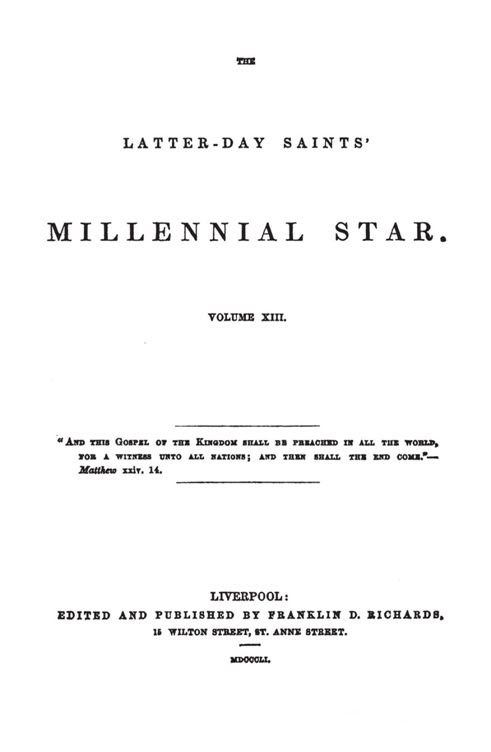
Millennial Star Notice - Publication of the Pearl of Great Price (1851)

The following notice, regarding publication of The Pearl of Great Price appeared in The Latter-day Saints' Millennial Star, Volume 13, Issue 14 (July 15, 1851). Elder Franklin D. Richards was the newest member of the Quorum of the Twelve Apostles at this time, and was serving as the British Mission President and editor of the Millennial Star, when he printed this notice relating to his forthcoming publication (see 1851 Pearl of Great Price document).

Sunday, January 24, 2010

The Pearl of Great Price - 1851

The following images are from the first printing of the Pearl of Great Price, published by Elder Franklin D. Richards, of the Quorum of the Twelve Apostles, in Liverpool, England, in 1851. Excepting the title page, preface, and contents, only the Book of Abraham is included.

Click here for pdf.
Note: The entire Pearl of Great Price [1st Ed. 1851] is available online now. See Here.