I want to say to you, read the book, the Pearl of Great Price, and read the Book of Abraham. The Pearl of Great Price I hold to be one of the most intelligent, one of the most religious books that the world has ever had; but more than that, to me the Pearl of Great Price is true in its name. It contains an ideal of life that is higher and grander and more glorious than I think is found in the pages of any other book unless it be the Holy Bible. It behooves us to read these things, understand them: and I thank God when they are attacked, because it brings to me, after a study and thought, back to the fact that what God has given He has given, and He has nothing to retract." - Levi Edgar Young, Conference Report (April 1913), 74

"...it must be evident to all who seriously consider the matter, that if the Book of Abraham as given to us by Joseph Smith be true, it must have been translated by a greater than human power." - George Reynolds, The Book of Abraham: Its Authenticity Established as a Divine and Ancient Record (Salt Lake City: Deseret News, 1879), 4

Monday, February 13, 2012

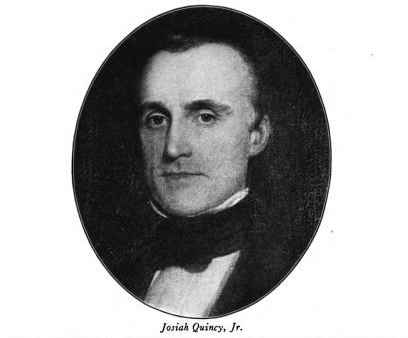
Josiah Quincy and The Book of Abraham

Josiah Quincy, Jr., Mayor of Boston, Massachusetts, from 1845-1849, is occasionally cited by Latter-day Saints for his profound statement regarding future American history and the Prophet Joseph Smith.  Quincy predicted that future history books might rightly assert that among 19th century Americans, Joseph Smith, Jr. exerted the most powerful influence upon the destinies of his countrymen than any other figure.1  Quincy had visited Nauvoo in mid-April 1844 with his distant cousin Charles Francis Adams, Sr. (son of U.S. President John Quincy Adams). While in Nauvoo, they viewed the papyri and mummies and both made note of the occasion, although Quincy was more extensive in his documentation. 
Sunday, February 12, 2012

Henry Caswall and the Book of Abraham

The Reverend Henry Caswall was an Anglican clergyman who visited Nauvoo in mid-April, 1842.  He was associated with the small Kemper College, near St. Louis, Missouri, where he actually spent most of his time officiating for Sunday services. Caswall was one of the more influential anti-Mormon writers of the 19th century, primarily because of his Greek Psalter episode with the Prophet Joseph Smith.1  During his three days visit in Nauvoo, he personally witnessed the papyri kept in a chest of drawers in the Prophet's office, and the mummies that Lucy Mack Smith maintained in her home. While in Joseph's office Caswall viewed "glazed slides, like picture frames, containing sheets of papyrus, with Egyptian inscriptions and hieroglyphics." These sheets of papyrus included Facsimile 1. In another drawer, Caswall may have seen Facsimile 2.

Caswall's account of this incident is recorded in his book, The City of the Mormons, and was summarized in his next book, The Prophet of the Nineteenth Century. The relevant portions from both books relating to the papyri and mummies are included below.

Wednesday, February 8, 2012

Reminiscences of Nauvoo - Robert Horne

In 1893, Robert Horne related his reminiscences of life while living in Nauvoo. Having visited the Prophet's mother (Lucy Mack Smith), he was able to see the mummies and papyrus. Horne recalls that both the Book of Abraham and the Book of Joseph were included in the papyri, and he indicates that the papyri included black and red writings [rubrics].  He also recalls seeing four mummies and even grabbed the breastbone of one of them.  His reminiscences were recorded in the Millennial Star 60/36 (Sept 4, 1893):585.


Saturday, January 28, 2012

Dr. John Riggs - The Joseph Smith Papyri and Charles Anthon

In Edward Tullidge's periodical, Tullidge's Quarterly Magazine, he provided a History of Provo (Volume 3, beginning on page 233) that included biographies of many prominent settlers and leaders. One of those prominent Provo residents in the medical profession was Dr. John Riggs. Dr. Riggs' father owned the only hotel in Kirtland, Ohio, when Oliver Cowdery, Parley P. Pratt, Peter Whitmer, Jr., and Ziba Peterson passed through while on their mission to proselytize the Lamanites.  According to Riggs, his father put up Michael Chandler at the hotel when he visited Kirtland with the mummies and papyrus in 1835. Interestingly, according to Dr. Riggs, Michael Chandler had with him a translation of some of the text on the papyri that he obtained from Dr. Charles Anthon (the well-known linguist that Martin Harris had visited with seven years previously in regards to the translation of the Book of Mormon). When the Prophet was invited to translate the papyri by Chandler, Dr. Riggs, who was present when the Prophet presented his translation, noted that the "translation of the Prophet and the professor [Anthon] agreed so far, but "there was one language Professor Anthon could not translate which the Prophet did."" This implies that multiple texts were on the papyri written in at least two different languages.

This account is documented in Tullidge's Quarterly Magazine 3/3 (July 1884): 283:

Sunday, January 15, 2012

Mormon Doctrine of Deity - BH Roberts 1903

The Mormon Doctrine of Deity: The Roberts-Van Der Donckt Discussion was a book published by the Deseret News in 1903. The first three chapters comprise a discussion between BH Roberts and the Reverend C. Van Der Donckt, a priest in the Roman Catholic Church from Pocatello, Idaho. After this discussion, Elder Roberts included excerpts from scriptures regarding Deity, including extracts from the Book of Abraham. 


Journal of Discourses - Orson Pratt - 1878

In August 1878, Orson Pratt delivered a discourse regarding revelation.  In his discourse he recounted some of the revelations and scriptures given by the Lord through the Prophet Joseph Smith and in connection with this, Elder Pratt briefly discussed the history of the Book of Abraham as it was understood at that time. He also mentioned that through revelation Joseph Smith could translate by aid of the Urim and Thummim. The portion of his discourse regarding the Book of Abraham is found in Journal of Discourses, 20:64-65.

Saturday, January 14, 2012

Millennial Star Notice - Book of Abraham Publication

The following notice by Parley P. Pratt, Apostle and Editor of the Millennial Star, in Volume 3, Issue 2 (June 1842), page 32 of the MS, was given to notify the Saints that extracts from The Book of Abraham would be published beginning in the following month's issue - online here.


Sunday, December 18, 2011

Book of Abraham "A Most Remarkable Book"

The Foundation for Apologetic Information and Research ("FAIR") has recently produced a 70 minute DVD regarding the Book of Abraham (written and directed by Tyler Livingston, and edited by JD Julander).  The DVD also contains 30 minutes of bonus features. 

Per FAIR: "The Book of Abraham is considered a volume of holy scripture by the Church of Jesus Christ of Latter-day Saints.  It has been a source of inspiration and edification for its readers for many generations. However, critics of the LDS Church have relentlessly attacked the authenticity of the Book of Abraham and the credibility of Joseph Smith as an inspired prophet and translator. This video produced by the Foundation for Apologetic Information and Research (FAIR) addresses some of these criticisms and puts forth evidence for the divine authenticity of this most remarkable book."

Purchase the DVD for $12.99 (tax included) here.

Edit: Now available online (full length + bonus features):


Young Woman's Journal - Book of Abraham History

In a serial article published in the Young Woman's Journal by the Guide Department, entitled "The Story of the Restoration," the history of the Book of Abraham, as it was then understood, was recorded as the twelfth installment of this history, under the title "Sacred Writings of Old."  This article was published in the 21st volume of the Young Woman's Journal, Issue number 12, in December 1910.


Astronomy of Abraham - Andrew Jensen

On January 16, 1891, Andrew Jensen delivered a lecture to the 'Student's Society' in the Social Hall in Salt Lake City, Utah. His discourse focused on different aspects of Joseph Smith's prophetic calling.  This lecture was published the same year in The Deseret Weekly and also in the Millennial Star in several installments. A portion of his lecture relating to modern astronomy and elements of astronomy discussed in the Book of Abraham was published in The Deseret Weekly 42/12 (March 14, 1891): 355-356, and Millennial Star 53/16 (April 20, 1891): 241-242. Both extracts are provided below.


Sunday, November 13, 2011

The Apocalypse of Abraham - G.H. Box 1918

The following translation and commentary on The Apocalypse of Abraham was provided by G.H. Box, in 1918. The original text was probably written in Hebrew or Aramaic, from which a Greek version was made. The following translation is from a Slavonic text which was based on the Greek version. Box believes the date of the original composition to be the end of the first century, or beginning of the second century A.D. The date of the Slavonic text is probably from the fourteenth century A.D. I've included his comments as well as the translation to provide a greater context regarding the translation of the text.


Saturday, November 12, 2011

The Testament of Abraham

The following translation was published in the ninth volume of the Ante-Nicene Fathers in 1896, and was translated by W.A. Craigie, M.A., B.A..  Latter-day Saint scholars such as Hugh Nibley, Michael Rhodes, Kerry Muhlestein, Larry Morris, Brian Hauglid, Jared Ludlow, and others have noted parallels between The Testament of Abraham and The Book of Abraham - see here


Monday, August 15, 2011

BYU Academic Review - N.L. Nelson - 1885

Nels Lars (N.L.) Nelson was a professor of English at Brigham Young University. Graduating from the Brigham Young Academy in 1882, he was subsequently placed in charge of the intermediate department until serving for two years in the Southern States Mission from 1885 to 1887. Following his return, he taught full-time at the school until 1920. The following article on the Book of Abraham was published in the March 1885 issue of the school's periodical, The Academic Review.1


Tuesday, July 5, 2011

Times and Seasons - John Taylor - 1843

The following comments were published by John Taylor, Apostle and Editor of the Times and Seasons, in the February 1843 issue of the LDS periodical. This issue included a notice from Elder Taylor that "further extracts" (subsequent to Abraham 5:21) would be forthcoming. Unfortunately, this is the last reference to the Book of Abraham in the Times and Seasons as there was no additional publication of scriptures from the Book of Abraham.


Wednesday, June 1, 2011

Pearl of Great Price as Canon - Salt Lake Tribune - Oct 11, 1880

During the 1880 October Session of the General Conference of the Church of Jesus Christ of Latter-day Saints, in connection with certain revelations being added to the Doctrine and Covenants, the Pearl of Great Price was also sustained by the conference as "revelations from God," and was implicitly sustained as one of the standard or canonical works recognized by the Church as scripture. The following excerpt relating to this sustaining is extracted from page four of the October 11, 1880 issue of the Salt Lake Tribune.  A full copy of this page of the paper can be seen here.


Wednesday, May 18, 2011

Parley P. Pratt on The Book of Abraham

The following comments were published by Parley Pratt, Apostle and Editor of the Millennial Star, in the 1842 issue of the LDS periodical, as a preface to the publication of the Book of Abraham. Elder Pratt's comments provides some of the history of the finding of the papyri and mummies that the Church purchased in 1835.


Tuesday, May 17, 2011

The Apocalypse of Abraham

The following translation of the Apocalypse of Abraham, from the Romanian text, by Dr. Moses Gaster, was published in the Transactions of The Society of Biblical Archaeology in 1893.


Tuesday, April 26, 2011

The Ulterior Motives of Reverend Franklin S. Spalding


Reverend Franklin S. Spalding1

Almost 100 years ago, Reverend Franklin Spencer Spalding, an Episcopalian Bishop in Utah, published a 36 page booklet that was circulated amongst LDS officials, college professors, high school teachers, and students.2 The pamphlet was meant to discredit the Book of Mormon by illustrating that Joseph Smith's ability to translate the facsimiles contained in the Book of Abraham could not hold up to the scrutiny of Egyptologists. If Reverend Spalding could successfully illustrate that Joseph did not translate Egyptian accurately, then it may be inferred that his translation of the Book of Mormon should not only be called into question, but dismissed altogether. Apparently it did not occur to Reverend Spalding that the success of his experiment was dependent on some logical fallacies, a subject that will be addressed in a later posting; nevertheless, Spalding's efforts elicited quite a response in relation to some potentially serious implications for the Book of Abraham.

Friday, January 7, 2011

RC Webb - The Case Against Mormonism

Despite its foreboding title, Robert Charles Webb's book The Case Against Mormonism, is an apologetic work defending Mormonism against the common anti-Mormon arguments prevalent at the time it was published. Webb himself was not a member of the Church of Jesus Christ of Latter-Day Saints, but was favorable to their cause.1 The book was published in 1915 in New York, and came mostly as a response to Reverend Henry C. Sheldon, a Professor at Boston University, who had written a book entitled A Fourfold Test of Mormonism.2 Sheldon briefly discusses the Book of Abraham facsimiles and the responses of Egyptologists consulted by Reverend Franklin S. Spalding, and previously by Jules Remy. Webb's book briefly addresses these particular issues, as well as Sheldon's approach. This portion of Webb's book is included below.3


_________________________
1 'Robert Charles Webb' was a pseudonym for James Edward Homans.  Homans was a Harvard graduate who had studied at the Harvard Divinity School.  He was an Episcopalian and was a writer by profession. He was friendly towards the Church of Jesus Christ of Latter-Day Saints, and had published articles and books relating to Mormonism previous to this publication, and subsequent thereto; see Kevin Barney, "Robert C. Webb," By Common Consent; also see Sidney B. Sperry, "The Story of Research on The Pearl of Great Price," in Pearl of Great Price Conference, December 10, 1960, ed. James R. Clark (Provo, UT: Department of Extension Publications, Adult Education and Extension Services, Brigham Young University, 1964), 6-11; additionally, see James E. Talmage Diary, dated December 1, 1915 (typescript in my possession):  "About noon I received a call, as per prior arrangements, from James E. Homans.  We lunched together and spent some time in the discussion of the work on which Mr. Homans has been for some time engaged, the preparation of articles and books on subjects relating to Mormonism.  Mr. Homans delivered to me today a copy of a 157 page work entitled "The Case Against Mormonism" by himself.  Instead of his own name he uses on the title page the pen-name, Robert C. Webb, under which he has written in this particular field of literature. The book is a reply to a little work which appeared somewhat over a year ago, entitled, "A Fourfold Test of Mormonsim" by Prof. Henry C. Sheldon, of Boston University.  The Webb's [sic] reply is published by L.L. Walton of the Sturgis and Walton Company. In company with Mr. Homans I visited the offices of Sturgis and Walton, and ordered five hundred copies of "The Case Against Mormonism" to be shipped at once to the office of the Deseret News, Salt Lake City."
2 Henry Clay Sheldon, A Fourfold Test of Mormonism (New York: Abindgon Press, 1914), 23-25
3 Henry C. Sheldon's book is not included in the Documents on this blog because there is no original insights produced in his writing; he simply summarizes Remy's findings, which is available here; and Spalding's findings, which is available here.

Theodule Deveria - Memoires et Fragments

In 1855, Jules Remy (a Frenchman) and Julius Brenchley (an Englishmen) visited Salt Lake City.  Upon their return home they presented to Theodule Deveria "drawings which we borrowed from the Mormons [the Facsimiles from the Book of Abraham]" with a request that he would translate them from Egyptian into French. Deveria obliged, and his translation made in 1859 was subsequently published in 1860 by Jules Remy in his book Voyage Au Pays Des Mormons.1 

At the time of translation, Deveria was a young Egyptologist working in the Louvre Museum. He first took an interest in Egyptology at the age of seventeen and subsequently obtained an education from the College of France. In 1850 he performed some Egyptian translations for the Sevres Museum (Paris, France), and in 1851 he began working in the print room in the National Library. In 1855, Deveria began work at the Louvre Museum in Paris, and five years later he was appointed as Assistant Curator of the Egyptian Museum (at the Louvre).2 Before turning thirty years old, Deveria, described as a "young savant," provided Remy with his translation of the facsimiles.3


 Theodule Deveria4